
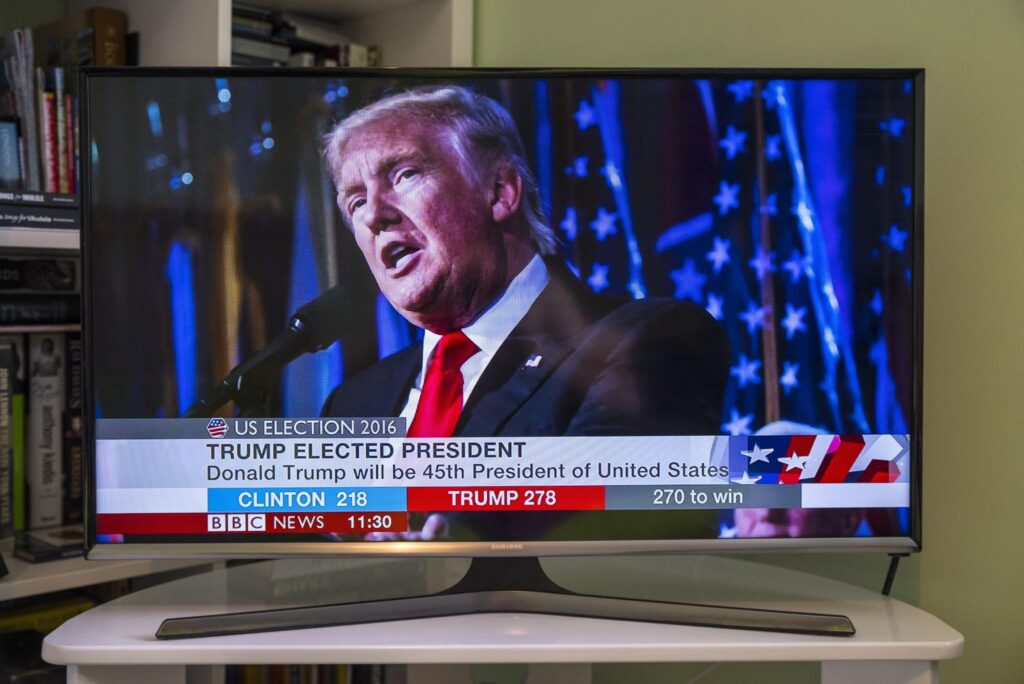
By issuing a lawsuit against the BBC, the US President is seeking to challenge, expose, and delegitimize institutions.
From the outside, Donald Trump’s lawsuit against the BBC looks like many things at once, and almost none of them turn primarily on whether he was defamed in the narrow legal sense. That question will matter in court, of course, and it will be governed by familiar and demanding principles of United States law. But to treat the case as being chiefly about reputational harm is to miss what gives it its real poignancy. This claim is better understood as a proxy, a vehicle through which a more profound issue is engaged, one that is less concerned with a single documentary edit than with the authority and self-conception of the BBC itself.
Trump has sued the BBC in federal court in Florida, alleging that a documentary misrepresented his 6 January speech by editing together passages delivered nearly an hour apart in a way that conveyed a call to violence. The BBC has accepted that the edit was wrong, has apologised, and has insisted that it was unintentional and, in any event, not defamatory. On the surface, this is a familiar dispute about claimed editorial error, its meaning, and its effects. Looked at from the outside, however, it is something more expansive and more consequential.
For Trump, the claim does not need to succeed to achieve its purpose. His public reputation is already settled, polarised, and largely immune to marginal damage. What the litigation offers instead is a forum, one with formal authority and procedural compulsion, in which long-standing grievances about media institutions can be pressed, his “fake news” and anti-Trump media-bias agenda not as opinion, but as evidence. In that sense, the lawsuit functions as a proxy for a wider political project, one that seeks to challenge, expose, and delegitimize institutions that present themselves as neutral arbiters of truth while, in Trump’s telling, operating with unacknowledged ideological commitments.
Seen that way, the BBC is not simply a defendant. It is a stand-in. The claim becomes a way of putting a particular conception of public broadcasting on trial, one rooted in moral authority, professional judgment, and the assumption of good faith. The question being asked is not only whether a programme misled viewers, but whether the institution that produced it can still credibly claim the posture of impartiality on which its standing depends.
Until now, the BBC has been dealing with a controversy it might reasonably have expected to manage. It acknowledged the error. It apologised. Senior editorial figures were removed or resigned. An internal memorandum laid out how the programme reached broadcast and how concerns were handled. These are the familiar rituals of institutional self-correction, designed to restore confidence and allow the organisation to move forward.
From the outside, those same steps look different once litigation begins. Apology ceases to be closure and becomes context. Internal review ceases to be reassurance and becomes potential evidence. What was intended as transparency for the audience becomes a record for adversarial scrutiny. The focus shifts from what went wrong on screen to what happened behind it: how and why decisions were taken, how dissent was treated, how confident assumptions hardened into editorial certainty. Wider questions of bias, alleged or otherwise, with examples, will be aired in court.
Courts do not operate on trust or reputation. They reconstruct events through documents and testimony, and they do so without deference to institutional pedigree. For an organisation whose authority has long rested on being believed rather than proved, that change of terrain matters. Any implicit comfort the BBC might once have felt from appearing before an English judge, steeped in its cultural authority, does not travel to a Florida courtroom, particularly one sitting in Trump’s home state.
The imbalance between the parties sharpens the effect. Trump arrives with little to protect and much to gain from the process itself. Disclosure, delay, and public examination all serve his narrative, regardless of outcome. The BBC, by contrast, is defending something far more delicate and profound. Its legitimacy depends on a shared willingness to believe that it acts impartially and in good faith, even when it errs. Once that willingness is strained, and internal communications are read without charity, the risk is not simply losing a case, but fixing a story about what the BBC is and how it operates.
From the outside, the familiar escape routes look narrow. Settlement risks entrenching the allegation, quite apart from the fact that paying anything remotely close to what is claimed is inconceivable. Defending the litigation may delay matters, but it cannot be relied upon to make the case disappear. An honest-mistake defence invites precisely the scrutiny of process and culture that the BBC would prefer to keep internal. Each option carries a cost. None restores the presumption of authority that once allowed the organisation to move on from controversy.
This is why the lawsuit resonates beyond its legal merits. It speaks to a broader moment in which institutional legitimacy is no longer assumed, and in which public bodies are increasingly required to justify themselves in hostile settings. We are at something of a crossroads culturally and philosophically, with previously settled concepts such as democracy, nationhood, and inherited authority being questioned more keenly than at any point in recent memory. The BBC is subject to that shift, but it is particularly exposed to it, because so much of its authority rests on moral seriousness rather than coercive power.
What makes this lawsuit different is not the scale of the damages claimed, or even the sharpness of the allegations, but the position into which it forces the BBC. Public broadcasters are accustomed to being criticised, even fiercely, while remaining the arbiters of explanation. They correct, contextualise, and move on. This case denies the BBC that role. It places the organisation itself inside the frame, not as narrator but as subject.
From the outside, that inversion feels consequential. The BBC has long occupied a space in British public life that sits somewhere between institution and conscience, an authority that speaks with confidence precisely because it is assumed to stand above faction. Once that confidence has to be defended rather than exercised, something changes. Authority becomes conditional. Explanation is no longer enough.
The legal outcome will matter, but it will not settle that shift. A modest settlement might end the case without ending the question. A courtroom victory might still leave behind a residue of doubt. A defeat would accelerate a reckoning that is already underway. In every scenario, the BBC emerges altered, required to justify itself more often, more explicitly, and in less forgiving forums than before.
This is why the claim matters regardless of how it ends. It captures a moment in which institutions built on trust rather than force are discovering how exposed they become when trust wanes. The BBC did not choose this confrontation, but it cannot step around it. If it fights, it does so not merely to defeat a litigant, but to assert that the kind of authority it represents can still survive in a climate that no longer grants it automatically.
Whether it can do so is the unresolved question this case leaves behind. And that question, rather than the verdict itself, is what gives the lawsuit its lasting significance.