

The Law Society has renewed its call for mediation in Ireland’s criminal legal aid dispute as solicitors continue withdrawing services over a new flat-fee system. The society asked Justice Minister Jim O’Callaghan to proceed with an independent mediator, saying discussions should bridge the gap between his department and “the practical realities experienced within the courts.”
The request came in a letter from Law Society president Rosemarie Loftus before the formal opening of the new legal year on Monday. More than 100 criminal defence solicitors practising in Dublin voted unanimously to extend their withdrawal into October. Solicitors from elsewhere in the country are expected to join the action.
Flat Fee Replaces Per-Appearance Payments
The dispute centers on a system introduced on July 1. It pays solicitors a flat €520 for each legal aid case, regardless of how many court appearances the case requires. Under the previous arrangement, solicitors received about €240 for an initial district court appearance and another €60 for each later appearance. Payments therefore rose when cases required more time in court.
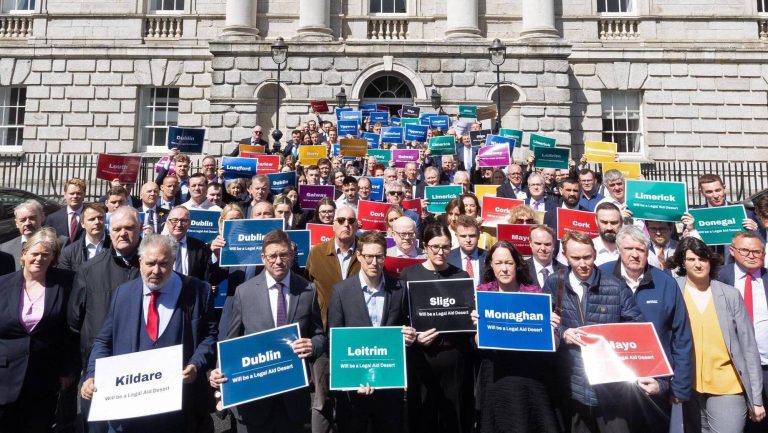
Solicitors around the country began withdrawing services after courts returned from the August break. Some have since returned to work, but the society says the disagreement remains unresolved. O’Callaghan previously rejected the society’s request for an independent mediator. He said he wanted to await the judgment, due on October 13, in a High Court challenge to the reforms introduced in July.
The parties also remain divided over two practical questions. Solicitors want to know whether legal aid certificates would be issued for separate cases committed on separate dates. They are also seeking clarity on whether a solicitor could apply for an additional certificate if a case extends beyond ten court appearances.
Law Society Points to Court Disruption
Loftus said court users had experienced “severe disruption” since July 1. She cited previously published figures showing a 93% reduction in legal aid certificates issued in July. August data showed a fall of 86% compared with August last year, with 394 certificates issued.
“We are hugely concerned at the impact the current dispute is having on victims of crime, those accused of crime, the general public and all court users,” Loftus said. She said growing case backlogs showed the short-term impact. For the longer term, she warned that the dispute could lead to a loss of skilled practitioners, pointing to the Civil Legal Aid scheme, which has lost more than 60% of practising solicitors from the scheme.
Loftus described the new criminal legal aid scheme as a “one-size-fits-all” approach that does not account for the complexity of cases before the courts. She said the society believes the system rests on a fundamental misunderstanding of how the district court works and prioritizes administrative efficiency over fairness.
The disagreement sits within broader questions about how criminal cases move through courts, including unresolved criminal law issues. Readers can also explore reporting on evidence in criminal cases and regulatory pressures on solicitors.
The High Court judgment due on October 13 is the next stated development in the challenge to the July reforms. Until then, the society’s mediation request and the solicitors’ withdrawal leave the dispute unresolved.